
Hastelloy C276 Fasteners are selected when ordinary stainless steel cannot reliably withstand aggressive chemicals, heat, and contamination risks. Their nickel-molybdenum-chromium composition offers strong resistance to pitting, crevice corrosion, and stress-corrosion cracking. These properties make them valuable in chemical processing plants, pollution-control equipment, pulp and paper systems, offshore facilities, and waste-treatment units.
The need is substantial. NACE International’s IMPACT study estimated that corrosion costs the global economy about $2.5 trillion annually, equal to roughly 3.4% of global gross domestic product. That figure explains why engineers protect small connections carefully. A single bolt beside a chlorine scrubber may face hot acid mist, vibration, and repeated maintenance cycles. If it seizes or fractures, replacing a gasket may become a larger shutdown.
Hastelloy C276 Fasteners are commonly used for reactor covers, pipe flanges, heat exchangers, ducting, pumps, and tank assemblies exposed to chlorides, sulfur compounds, or oxidizing media. AMPP standards and NACE corrosion-control guidance emphasize that alloy selection must match the actual chemical environment, temperature, stress, and fabrication condition. C276 is highly capable, but it is not invulnerable. Wrong washers, damaged threads, poor cleaning, or galvanic contact can still create failure points. That detail is often overlooked. Fastener performance also depends on correct torque, surface condition, and traceable material certification. In practice, engineers should review process data rather than choose the alloy from a corrosion chart alone. The better question is not whether C276 is expensive, but whether premature failure would cost more.
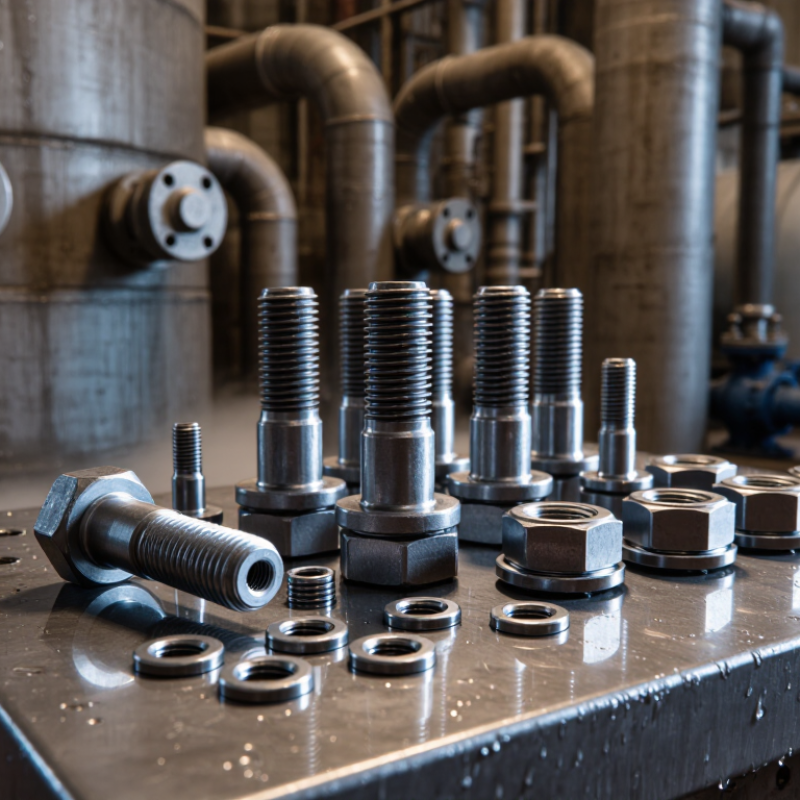
Hastelloy C276 is a nickel-based alloy containing chromium, molybdenum, and tungsten. This chemistry gives it strong resistance to pitting, crevice corrosion, and stress corrosion cracking. The alloy performs well in oxidizing and reducing environments, which makes it valuable for demanding fastener applications.
C276 fasteners are used with chemical reactors, scrubbers, heat exchangers, and process piping. They can secure flanges exposed to hydrochloric acid, wet chlorine, sulfur compounds, and mixed industrial chemicals. In wastewater treatment systems, bolts and nuts may face constant moisture, chlorides, and changing acidity. Ordinary stainless steel can deteriorate quickly under these conditions. C276 usually provides a longer service margin.
Installation still matters. The alloy is corrosion resistant, not installation-proof. Its threads can gall when dry, especially during repeated tightening. Clean tools, controlled torque, and a compatible lubricant help prevent seizure. Engineers should also check galvanic compatibility with adjoining metals. A cheaper carbon-steel washer may quietly weaken the entire connection.
Field experience shows that material selection must include temperature, chemical concentration, load, and cleaning cycles. C276 is not a magic solution. It may be unnecessary in mild environments, while its cost can be difficult to justify. More importantly, published corrosion data may not perfectly represent a plant’s real conditions. Trial inspections and qualified engineering review remain sensible before specifying these fasteners for critical equipment.
| Material or Application Dimension | Verified Data or Typical Specification | Why It Matters in Fasteners | Common Industrial Uses |
|---|---|---|---|
| Material identity | Hastelloy C276 is a nickel-chromium-molybdenum-tungsten corrosion-resistant alloy, commonly identified by UNS N10276. | The nickel-based matrix provides a combination of corrosion resistance, strength, and toughness for demanding service conditions. | Chemical-processing equipment, pollution-control systems, oil and gas equipment, and severe-service process plants. |
| Typical chemical composition | Nickel: balance; chromium: approximately 14.5–16.5%; molybdenum: approximately 15–17%; tungsten: approximately 3–4.5%; iron: approximately 4–7%. | Chromium supports resistance to oxidizing environments, while molybdenum and tungsten improve resistance to localized corrosion and reducing acids. | Fasteners exposed to mixed-acid process streams, chloride-bearing fluids, and contaminated chemical environments. |
| Low-carbon design | Carbon is typically limited to a maximum of about 0.01%, depending on the applicable material specification. | The low carbon level helps reduce carbide precipitation during welding and minimizes the risk of corrosion in heat-affected zones. | Bolted joints located near welded nozzles, fabricated vessels, piping assemblies, and repairable process equipment. |
| Resistance to pitting and crevice corrosion | The high molybdenum and tungsten content provides strong resistance to chloride-induced pitting and crevice attack compared with many conventional stainless steels. | Threads, washers, and contact areas are less likely to become initiation sites for localized corrosion when properly designed and installed. | Marine-process equipment, brine systems, scrubbers, seawater-related equipment, and chloride-containing chemical plants. |
| Resistance to stress-corrosion cracking | C276 is designed for improved resistance to stress-corrosion cracking in several aggressive chemical and chloride-containing environments. | This is important because fasteners remain under tensile preload and can be vulnerable to cracking when corrosion and stress act together. | Pressure-vessel covers, flanged pipe connections, heat exchangers, and equipment exposed to wet chlorides. |
| Acid service | The alloy is widely selected for resistance to many reducing and oxidizing acids, including sulfuric, hydrochloric, and mixed-acid environments; actual suitability depends on concentration, temperature, and contaminants. | Fasteners can maintain joint integrity where ordinary carbon steel or common stainless steel fasteners would corrode rapidly. | Acid reactors, transfer piping, scrubber systems, chemical storage equipment, and process-pump assemblies. |
| Indicative mechanical properties | For annealed wrought C276 product, commonly cited minimum values are approximately 690 MPa tensile strength, 283 MPa yield strength at 0.2% offset, and 40% elongation; fastener values depend on product form and specification. | The material offers useful load-carrying capacity and ductility, but the required design strength must be confirmed from the applicable fastener standard and mill certification. | High-integrity bolted joints where corrosion resistance is more critical than maximizing strength-to-cost ratio. |
| Temperature capability | C276 is used across a broad range of process temperatures, but allowable stress, oxidation behavior, creep, and corrosion rates must be evaluated for the specific service temperature. | Temperature affects preload retention, thermal expansion, gasket performance, and the corrosion mechanism acting on the fastener. | Hot chemical piping, furnace-adjacent equipment, flue-gas treatment systems, and elevated-temperature process vessels. |
| Fastener forms | Typical forms include hex-head bolts, heavy-hex bolts, studs, threaded rods, nuts, screws, and custom machined threaded components. | The appropriate form depends on joint geometry, preload requirements, installation access, maintenance frequency, and applicable dimensional standards. | Flanged connections, pressure equipment, pipe supports, removable covers, instrument connections, and custom corrosion-resistant assemblies. |
| Common specification considerations | Material may be supplied to nickel-alloy product specifications such as ASTM B574 for bar and ASTM B574/B575-related product requirements, as applicable. The exact fastener specification must be confirmed for the product form. | A material designation alone does not establish dimensions, proof load, tensile requirements, heat treatment, thread class, or inspection requirements. | Engineered projects requiring traceable material certificates, controlled manufacturing, and documented inspection. |
| Galvanic compatibility | C276 fasteners should be evaluated against the mating material, electrolyte, temperature, and joint geometry because galvanic effects depend on the complete assembly. | Using a highly corrosion-resistant fastener with a less noble mating material can shift corrosion risk to another component of the joint. | Mixed-metal flanges, lined vessels, marine installations, heat exchangers, and chemical equipment with dissimilar alloys. |
| Installation and galling risk | Nickel alloys can be susceptible to thread galling, particularly when similar alloy threads are assembled dry or repeatedly reused. | Controlled tightening procedures, clean threads, suitable compatible lubricants, and appropriate surface condition help protect preload accuracy and thread integrity. | Large studs, frequently serviced flanges, maintenance-access covers, and high-preload bolted joints. |
| Primary reason for selection | Hastelloy C276 fasteners are selected primarily when resistance to severe corrosion, localized attack, and chemical exposure is more important than the lowest purchase cost. | Longer service life and reduced risk of seized, weakened, or failed fasteners can improve equipment reliability and maintenance performance. | Severe chemical processing, flue-gas desulfurization, waste treatment, pollution control, oil and gas processing, and pharmaceutical process equipment. |
Note: Actual performance depends on alloy condition, fastener size, manufacturing method, installation practice, temperature, chemical concentration, contaminants, and joint design. Final selection should be based on the governing material and fastener specifications for the application.
They secure flanges, covers, pipe supports, and equipment panels in aggressive chemical environments.
They may perform well around hydrochloric acid, sulfuric acid, chlorides, wet chlorine, and mixed solutions. Conditions still matter.
No. They resist pitting, crevice corrosion, and stress corrosion cracking, but deposits and poor drainage can still cause damage.
Check chemical concentration, temperature, pressure, moisture, cleaning agents, thread dimensions, strength, and applicable standards.
Not necessarily. Heat treatment, manufacturing quality, material condition, and traceability can affect performance. The alloy name is not enough.
Keep threads clean, inspect mating surfaces, use approved lubricant, and follow controlled torque procedures.
They should not be used automatically. Approved engineering data should determine the correct torque values.
Yes. Evaluate the complete joint, including nuts, washers, mating materials, and possible galvanic effects.
Workers may hurry and damage the threads. That small defect can weaken the joint later.
No. Recheck torque after maintenance, inspect threads, and examine residues or narrow gaps. Resistance is not immunity.
Hastelloy C276 Fasteners are made from a highly corrosion-resistant nickel-based alloy designed to perform reliably in severe chemical and industrial environments. Their strong resistance to pitting, crevice corrosion, stress-corrosion cracking, and oxidation makes them suitable for applications involving acids, chlorides, high temperatures, and fluctuating operating conditions. These fasteners also provide excellent mechanical strength and durability, helping maintain secure connections where ordinary materials may deteriorate quickly.
Hastelloy C276 Fasteners are commonly used in chemical processing, pollution-control systems, power generation, marine equipment, and other demanding industries. Typical applications include flanges, pipelines, pressure vessels, heat exchangers, pumps, and exhaust or treatment systems. When selecting them, engineers should consider temperature, chemical exposure, load requirements, thread compatibility, and dimensional standards. Proper installation is equally important: compatible tools, suitable tightening procedures, clean contact surfaces, and careful prevention of galling can help ensure long-term performance and dependable joint integrity.