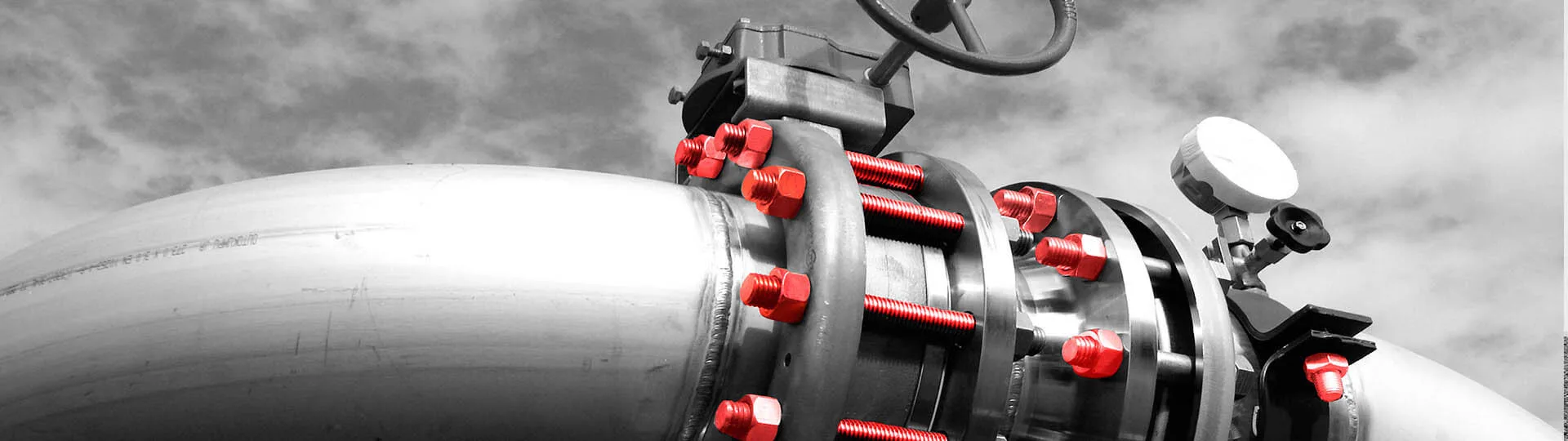
Heavy-duty industrial stud bolts and flange fasteners

Stud Bolts Manufacturer & Supplier

Engineered full-thread, double-end, and tap-end stud bolts in Inconel, Monel, Hastelloy, Duplex 2205, Super Duplex, Titanium, and Stainless Steel for high-pressure ASME flange joints, subsea manifolds, and chemical reactors.

ISO 9001:2015Accredited QMS facility
PED 2014/68/EUTÜV Rheinland pressure certified
EN 10204 3.1 / 3.2Full melt & heat traceability
NACE MR0175ISO 15156 sour gas compliance
Engineering Excellence

Precision-Machined & Rolled Alloy Stud Bolts

TorqBolt Inc. manufactures heavy-duty, high-tensile stud bolts engineered specifically for severe operational environments — including high-pressure hydrocarbons, cryogenic gases, acidic chemicals, and deepwater marine service.

Stud bolts eliminate head-to-shank stress concentrations inherent in standard headed bolts, distributing clamping loads evenly across flange assemblies. At TorqBolt, all threads are rolled under high hydraulic pressure wherever geometry permits — preserving continuous metallurgical grain flow, enhancing thread fatigue endurance by over 30%, and eliminating burrs that cause thread galling during high-torque hydraulic tensioning.

Manufactured from fully certified bar stock with traceable heat numbers, our stud bolts meet the demanding standards of major EPC contractors and international operators including Saudi Aramco, ADNOC, Shell, and Equinor specifications.

Structural Varieties

Stud Bolt Configurations & Mechanical Styles

Whether clamping ANSI/ASME B16.5 pipe flanges, securing pressure vessel bonnets, or fastening equipment bases, each stud configuration is manufactured to precise dimensional tolerances.

Fully threaded continuous stud bolt for pressure flanges

Full-Threaded Stud Bolts

Continuous thread along the entire length. The primary bolting choice for ASME B16.5 and B16.47 pipeline flanges, heat exchangers, and high-pressure valves.

Standard: ASME B18.31.2, DIN 976-1 Form A

Double end stud bolt with unthreaded center grip

Double-End Studs (Clamping)

Equal thread length at both ends separated by an unthreaded center shank. Used where unthreaded body carries shear loads across structural joints.

Standard: ASME B18.31.1M, DIN 975, BS 4439
Tap end stud bolt for blind threaded housings

Tap-End Stud Bolts

Short threaded end engineered for interference fit into blind tapped holes of valve bodies, pumps, or turbines; longer end accepts a standard nut.

Standard: DIN 938 (1D), DIN 939 (1.25D), DIN 940 (2D)
Waisted shank stud bolt for cyclic temperature duty

Waisted / Reduced Shank Studs

Reduced unthreaded shank diameter providing high elastic compliance to absorb cyclic thermal expansion and pressure pulsations without fatigue failure.

Standard: DIN 2510 Form L / K, BS 4882
Standard Compliance

Dimensional Standards & Thread Profiles

TorqBolt produces stud bolts in strict conformance with major American, British, German, and International manufacturing codes.

ASME / ANSI Standards

  • ASME B18.31.2 (Continuous Thread Studs)
  • ASME B18.31.1M (Metric Stud Bolts)
  • ASME B16.5 / B16.47 Flange Bolting
  • ASME B1.1 (UNC, UNF, 8UN Threads)
  • ASTM A193 / ASTM A320 Standards

DIN / EN Standards

  • DIN 976-1 (Form A & Form B Metric Studs)
  • DIN 938 (Tap End Studs 1d Engagement)
  • DIN 939 (Tap End Studs 1.25d Engagement)
  • DIN 940 (Tap End Studs 2.0d Engagement)
  • DIN 2510 (Bolts with Waisted Shank)

British (BS) Standards

  • BS 4882 (Bolting for Flanged Joints)
  • BS 4439 (Screwed Studs for General Use)
  • BS 2693 (Screwed Studs & Tapped Holes)
  • BS 1768 / BS 3692 Unified & Metric Specs
  • BS 1580 (Unified Thread Profile)

Thread Execution Options

  • UNC Coarse Thread (General Flange Bolting)
  • UNF Fine Thread (High Clamp Tightening)
  • 8UN Pitch (Sizes > 1" per ASME PCC-1)
  • ISO Metric 60° Coarse & Fine (ISO 68-1)
  • Stub Acme & Trapezoidal Power Threads
Metallurgy

Exotic Alloy & Stainless Steel Grade Matrix

Stud bolts operating in critical environments demand exact material chemistry and heat treatment. Review our standard production grades below.

Industrial Stud Bolt Material Specifications
Material Family Common Grade UNS Number Governing Specification Operating Limits & Service Environment
Alloy Steel (High Temp) ASTM A193 Gr. B7 / B16 G41400 / K42544 ASTM A193 / ASME SA193 Petroleum refining & steam boilers up to 540 °C (1000 °F)
Low Temperature Steel ASTM A320 Gr. L7 / L7M G41400 ASTM A320 / ASME SA320 Cryogenic and arctic pipeline service down to -101 °C (-150 °F)
Austenitic Stainless AISI 316 / 316L (B8M Cl. 1 & 2) S31600 / S31603 ASTM A193 / ISO 3506-1 Marine atmospheric, chemical processing, acid piping
Precipitation Hardening 17-4 PH (AISI 630) / 15-5 PH S17400 / S15500 ASTM A564 / AMS 5643 High tensile strength (up to 1300 MPa) for valve stems & pumps
Duplex Stainless Duplex 2205 (F51 / 1.4462) S31803 / S32205 ASTM A479 / ASTM A182 PREN ~35; high chloride resistance, seawater desalination
Super Duplex Super Duplex 2507 / Zeron 100 S32750 / S32760 ASTM A479 / NORSOK M-650 PREN >42; subsea manifolds, aggressive marine sour service
Nickel-Chromium Alloy Inconel 718 / Inconel 625 N07718 / N06625 ASTM B637 / API 6A CRA Gas turbines, aerospace, high-pressure sour wells to 650 °C
Nickel-Copper Alloy Monel 400 / Monel K-500 N04400 / N05500 ASTM F468 / QQ-N-286 Hydrofluoric acid alkylation, marine prop shafts, non-magnetic
Nickel-Molybdenum Hastelloy C276 / Alloy C22 N10276 / N06022 ASTM B574 / ASME SB574 Wet chlorine gas, hypochlorite, flue gas desulfurization (FGD)
Titanium Alloys Grade 2 (CP) / Grade 5 (Ti-6Al-4V) R50400 / R56400 ASTM B348 / ASTM F468 Extreme strength-to-weight ratio, zero seawater pitting attack

* Supplementary testing including elevated-temperature tensile, Charpy V-notch impact down to -196 °C, and intergranular corrosion tests per ASTM A262 are conducted per project requirements.

Surface Protection

Protective Coatings & Anti-Galling Platings

In high-torque flange tightening and aggressive coastal environments, the correct coating protects against galvanic corrosion, prevents galling, and maintains consistent friction coefficients.

Engineered Coating Systems

TorqBolt applies high-performance surface treatments in controlled environments to verify thickness uniformity, adhesion strength, and thread pitch clearance.

PTFE Xylan 1070 / 1024 Hot Dip Galvanizing (ASTM A153) Zinc-Nickel (Zn-Ni) Plating Cadmium Plating with Chromate Electroless Nickel (ENP) Manganese Phosphate Coating Dacromet 320 / 500 Electro-Zinc Plating (ASTM F1941) Silver Plating (High Temp Anti-Seize) Pickled & Passivated (ASTM A380)

Performance Features

PTFE / FluoropolymerProvides uniform friction coefficient (µ = 0.08–0.12) ensuring exact pre-load bolt tension during hydraulic torqueing; resists 1,500+ hrs salt spray per ASTM B117.
Hot-Dip GalvanizedSacrificial zinc coating per ASTM A153 / ISO 1461 providing 50–85 µm thickness for heavy industrial structural & bridge applications.
Zinc-Nickel PlatingAutomotive and offshore grade providing exceptional sacrificial barrier protection without hydrogen embrittlement concerns; 1000+ hrs to red rust.
Electroless NickelExtremely hard, pore-free nickel-phosphorus layer providing internal wear resistance and barrier protection for valve and downhole studs.
Testing & Compliance

Quality Assurance, Traceability & Testing

All stud bolts are manufactured under an audited ISO 9001:2015 quality management system. Chemical, mechanical, and non-destructive testing are executed on every production lot.

EN 10204 Type 3.1Standard mill test certificate with actual melt chemistry, mechanicals, and heat lot.
EN 10204 Type 3.2Independent third-party inspection witnessed by DNV, TUV, Lloyd's, BV, or SGS.
PED 2014/68/EUApproved manufacturer for pressure equipment bolting under European directive.
NACE MR0175 / ISO 15156Controlled hardness & microstructural verification for sour H2S wellheads.

TorqBolt maintains complete 100% heat traceability. Every individual stud bolt is stamped with its material grade and unique production heat code, ensuring absolute accountability throughout its operational lifecycle.

Standard & Supplementary Inspection Protocols

  • Positive Material Identification (PMI via XRF / OES)
  • Ambient & Elevated-Temperature Tensile Testing
  • Charpy V-Notch Impact Testing (to -196 °C)
  • Rockwell / Brinell Hardness Mapping
  • Microstructure & Ferrite Phase Analysis (ASTM E562)
  • Intergranular Corrosion Testing (ASTM A262 Practice E)
  • Magnetic Particle (MPI) & Liquid Penetrant (DPI)
  • Thread Pitch Diameter Go/No-Go Ring Gauging
  • Salt Spray Environmental Testing (ASTM B117)
  • Ultrasonic Flaw Detection (UT) for Large Bar Diameters
Comprehensive Range

Alloy & Special Grade Availability

Our raw material inventory accommodates standard, sour service, and custom alloy stud bolt requirements across all process metallurgy specifications.

Stainless Steel & High-Temperature Stainless Stud Bolts
AISI 304 / 304L / 304H AISI 316 / 316L / 316Ti / 316H AISI 321 / 321H AISI 347 / 347H AISI 310 / 310S / 310H AISI 317 / 317L AISI 410 / 420 / 430 AISI 446 / 446C 17-4 PH (AISI 630) 15-5 PH Stainless A286 (ASTM A453 Gr. 660) AISI 904L (UNS N08904) 254 SMO (UNS S31254) AL-6XN (UNS N08367) Nitronic 50 / Nitronic 60
Nickel Alloys & Superalloys
Inconel 600 (UNS N06600) Inconel 601 (UNS N06601) Inconel 625 (UNS N06625) Inconel 718 (UNS N07718) 718 NACE MR0175 Inconel X-750 (UNS N07750) Incoloy 800 / 800H / 800HT Incoloy 825 (UNS N08825) Incoloy 925 (UNS N09925) Hastelloy C276 (UNS N10276) Hastelloy C22 (UNS N06022) Hastelloy B2 (UNS N10665) Monel 400 (UNS N04400) Monel K-500 (UNS N05500) Nimonic 75 / 80A / 90 Waspaloy (UNS N07001) Alloy 20 (UNS N08020) MP35N Superalloy
Duplex, Titanium & Non-Ferrous Alloys
Duplex 2205 (UNS S31803 / S32205) Super Duplex 2507 (UNS S32750) Zeron 100 (UNS S32760) Titanium Grade 2 (CP) Titanium Grade 5 (Ti-6Al-4V) Cupronickel 90/10 (C70600) Cupronickel 70/30 (C71500) Aluminium 7075-T6 Phosphor Bronze PB1 / PB2 Silicon Bronze 655 / 651 Naval Brass 464
Procurement Checklist

Request for Quotation (RFQ) Guidelines

To obtain an accurate technical proposal and expedited lead time for industrial stud bolts, ensure your purchase requisition includes the key engineering parameters listed below.

Material Specification
Alloy name, grade, or UNS designation (e.g., ASTM A193 B7, Inconel 718, or UNS S32750).
Configuration & Dimensions
Full-threaded, double-end, or tap-end; overall length (OAL) or grip length; diameter size.
Thread Pitch & Class
UNC, UNF, 8UN, or metric pitch; thread tolerance class (Class 2A/3A or 6g).
Applicable Standard
ASME B18.31.2, DIN 976, DIN 938/939, BS 4882, or customized manufacturing drawing.
Protective Coating
PTFE / Xylan 1070 blue, hot-dip galvanizing, electro-zinc, zinc-nickel, or plain oiled.
Inspection & Certs
EN 10204 3.1 or 3.2 TPI witnessed, NACE MR0175 sour service, PED 2014/68/EU.
Mating Components
Quantity of matching heavy hex nuts (ASTM A194) and hardened washers per stud.

Direct Manufacturer Support

TorqBolt engineers collaborate directly with project procurement managers, piping designers, and QA inspectors worldwide to ensure compliant fastener packages delivered on schedule.

Factory LocationRajkot & Mumbai, India
Export Network50+ Countries Worldwide
Quality SystemsISO 9001:2015 & PED Approved
Testing FacilityIn-House Mechanical & PMI Lab
Technical FAQ

Frequently Asked Questions — Stud Bolts

What is the difference between rolled threads and cut threads on stud bolts?
Rolled threads are formed by plastic deformation under high hydraulic pressure using hardened steel dies. This process burnishes the thread root, preserves continuous unbroken metallurgical grain flow, creates compressive residual stresses, and eliminates micro-notches. Rolled threads deliver superior fatigue life and resistance to cyclic thermal-pressure stresses compared to cut or machined threads. TorqBolt utilizes thread rolling across its standard size range.
Why is 8-thread series (8UN) specified on stud bolts over 1 inch diameter?
Per ASME B1.1 and ASME B16.5 flange bolting practices, diameters greater than 1 inch utilize the 8UN constant pitch thread profile (8 threads per inch) rather than UNC coarse threads. This provides a more favorable pitch-to-diameter ratio, prevents thread strip-out, reduces bolt torque required to achieve target gasket pre-loads, and improves hydraulic tensioning efficiency.
Can TorqBolt supply matching heavy hex nuts with identical material traceability?
Yes. Every stud bolt order can be supplied completely assembled or kitted with matching heavy hex nuts (e.g., ASTM A194 Gr. 2H, Gr. 7, Gr. 8, Gr. 8M, Gr. 4, or matching exotic alloys like Inconel 718 / Duplex 2205) and hardened washers (ASTM F436 / DIN 125). All nuts carry verified proof loads and hardness values to prevent galling during assembly.
What are typical production lead times for custom exotic alloy stud bolts?
Standard stock alloys (ASTM A193 B7, B8, B8M, 316L, Duplex 2205) frequently ship within 1 to 2 weeks. Custom-manufactured, large-diameter, or high-nickel alloys (Inconel 718, Super Duplex 2507, Hastelloy C276) with specialized heat treatments or 3.2 third-party inspection typically deliver in 3 to 5 weeks. Emergency project turnaround services are available upon request.
How do you verify stud bolts for sour gas (H2S) service?
For sour service compliance under NACE MR0175 / ISO 15156, stud bolts (such as ASTM A193 Gr. B7M, B8M Cl.1, or Inconel 718) undergo strict heat treatment cycles followed by 100% individual or batch hardness testing to verify maximum hardness limits (e.g., 22 HRC max for B7M; 35 HRC max for aged Inconel 718). Microstructural checks and sulfide stress cracking (SSC) resistance documentation are provided in the EN 10204 3.1 inspection dossier.

Need Engineering Data or Immediate Project Quotation?

Download our technical stud bolt dimension catalogs, torque charts, and alloy compatibility guides, or connect with our metallurgists for technical confirmation.

Get Catalog
Contact Us