Delivering high-tensile integrity, metallurgical traceability, and superior corrosion resistance across global energy pipelines, offshore platforms, and subsea structures.
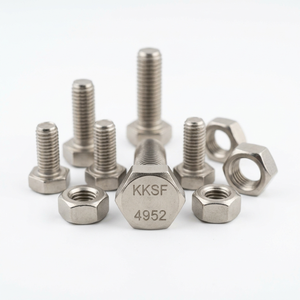
The ASTM A193 Grade B8M specification represents the global engineering gold standard for austenitic stainless steel bolting materials utilized in pressure vessels, valves, flanges, and fittings intended for high-pressure, high-temperature, and corrosive operating environments. Chemically based on AISI 316 / 316L molybdenum-bearing austenitic stainless steel, ASTM A193 B8M fasteners provide significantly heightened pitting and crevice corrosion resistance compared to basic 18-8 chromium-nickel counterparts (such as Grade B8 / AISI 304).
As an established, world-class manufacturing authority operating out of China's advanced metallurgical corridor, our facility bridges the critical gap between precise raw material smelting control, certified heat treatment, and precision thread-rolling operations. Sourcing managers and EPC mechanical engineers must rigorously distinguish between the standard mechanical conditions governed by ASTM A193:
| Property Parameter | ASTM A193 B8M Class 1 | ASTM A193 B8M Class 2 | Engineering Significance |
|---|---|---|---|
| Processing Route | Carbide Solution Annealed | Carbide Solution Treated + Strain Hardened | Class 2 introduces severe cold work to expand yield strength boundaries. |
| Yield Strength min. (0.2% Offset) | 30 ksi (205 MPa) | 65 to 95 ksi (450 to 655 MPa) | Class 2 delivers more than 2x load-bearing capacity without flange relaxation. |
| Tensile Strength min. | 75 ksi (515 MPa) | 90 to 125 ksi (620 to 860 MPa) | Essential for high-pressure ASME B16.5 & B16.47 piping classes (600# to 2500#). |
| Elongation in 4D min. | 30% | 15% to 28% (diameter dependent) | Maintains critical ductility under cyclic seismic or thermal shock conditions. |
| Hardness maximum | 223 HBW (96 HRB) | 321 HBW (35 HRC) | Strictly governed to satisfy NACE MR0175/ISO 15156 sour gas operating limits. |
In our factory lines, thread execution is executed using high-capacity automated thread rollers after cold-drawing (for Class 2) rather than single-point turning. This cold-forming operation produces continuous, uninterrupted grain flow along the thread profile, enhancing root fatigue resistance by over 30% and eliminating micro-fissures where chloride-induced stress corrosion cracking (SCC) routinely initiates.
The worldwide procurement ecosystem for critical bolting components is undergoing systematic transformations driven by decarbonization technologies, extreme offshore drilling environments, and automated plant construction schedules. Enterprise buyers evaluating Chinese fastener factories are actively pivoting from mere base-cost calculations toward lifecycle durability and verifiable traceability:
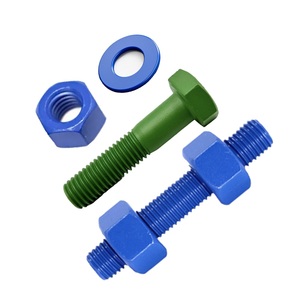
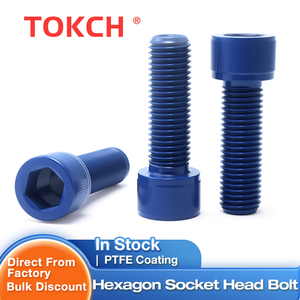
Rapid substitution of traditional hot-dip galvanizing with advanced multilayer PTFE coatings (Xylan 1424, Blue PTFE) capable of withstanding 3,000+ hours in ASTM B117 salt spray testing while stabilizing torque break-out coefficients.
Rigid enforcement of NACE MR0175 / ISO 15156 limits. Modern procurement contracts require 100% automated optical hardness verification to protect offshore gas infrastructures against lethal sulfide stress cracking (SSC).
Transition toward digital, cryptographically immutable Material Test Reports (MTRs) directly tied to raw billet ladle melts, ensuring absolute transparency from Chinese steel mills to deep-sea installations.
Direct mill-to-factory agreements minimizing middleman markups, permitting Tier-1 contractors to integrate full-range exotic assemblies (B8M, Inconel 718, Duplex 2507) within unified logistics frameworks.
Achieving long-term joint integrity in offshore LNG platforms and nuclear secondary cooling loops mandates state-of-the-art transformation in mechanical forming. Traditionally, manufacturers relied on batch hot-forging with manual pickling, introducing variable grain structures and sporadic carbon-contamination pockets.
Our manufacturing ecosystem integrates multi-station cold-heading mechanisms for studs and bolts up to M36 (1-1/2" diameter), maintaining strict axial alignment and zero surface decapitation. For heavy structural and non-standard flange bolting extending beyond M36 up to M100, medium-frequency induction hot-forging work-cells ensure rapid, uniform heating up to precisely 1050°C, followed by pressurized water-quench solution annealing. This rapid thermodynamic cooling locks chromium and molybdenum in solid solution, totally inhibiting chromium carbide precipitation at the grain boundaries (sensitization) and guaranteeing flawless performance in ASTM A262 Practice E intergranular corrosion evaluations.
Engineered manufacturing processes designed to satisfy stringent client audits, third-party witness testing, and continuous multi-ton project consignments.
Our comprehensive production system operates fully under ISO 9001:2015 frameworks and holds PED 2014/68/EU certification validated by TÜV Rheinland. Every lot is fully cleared for installation into high-hazard European pressure vessels.
Equipped with stationary optical emission spectrometers (OES), portable XRF analyzers for Positive Material Identification (PMI), hydraulic tensile testers up to 1000 kN, Charpy V-notch impact machines down to -196°C, and calibrated thread ring/plug gauges.
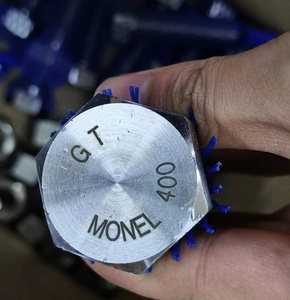
Eliminate multi-vendor friction. Alongside our core ASTM A193 B8M line, our Rajkot and China facility networks forge and machine Monel 400, Inconel 718/625, Hastelloy C276, and Super Duplex 2507 fasteners with synchronized lead times and standardized MTR formats.
Direct mill pricing, expedited production scheduling, and full metallurgical compliance for global energy, offshore, and petrochemical infrastructure projects.
Contact Us