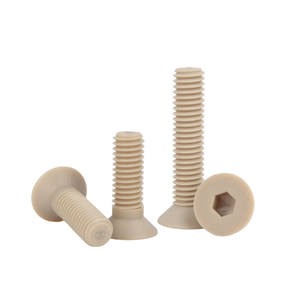
High Temp PEEK Countersunk Hex Socket Screw
Engineered for extreme operating environments reaching 260°C. Delivers outstanding dielectric properties, organic chemical inertness, and lightweight mechanical integrity tailored for semiconductor tools.

Precision-engineered continuously threaded rods and studs manufactured to ASTM, DIN, ASME, and ISO standards for demanding high-temperature, petrochemical, cryogenic, and subsea flange installations.
Engineered for extreme operating environments reaching 260°C. Delivers outstanding dielectric properties, organic chemical inertness, and lightweight mechanical integrity tailored for semiconductor tools.
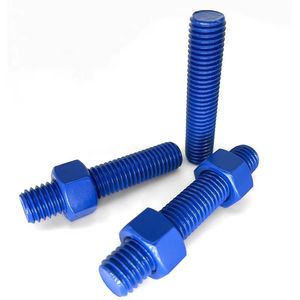
High-tensile ASTM A193 B7 alloy steel full-thread stud bolt with dual ASTM A194 2H heavy hex nuts. Finished with anti-corrosion blue PTFE fluoropolymer to eliminate friction galling in process pipelines.
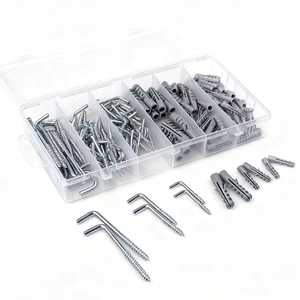
High-shear anchoring solutions with fish-shaped ribbed sleeves and electro-zinc finish. Engineered for dynamic vibration resistance in heavy equipment bases, masonry anchoring, and structural masonry fixtures.
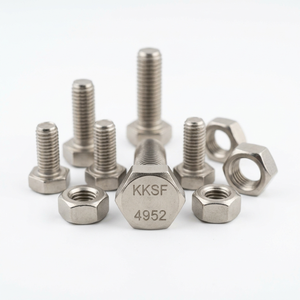
Commercial and industrial grade 304/316 austenitic stainless fastener sets. Designed for corrosive ambient exposures, water treatment facilities, structural framing, and general mechanical assembly.
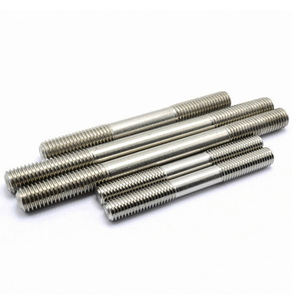
Manufactured to DIN 939 / DIN 835 specifications. Provides balanced clamping stress on pressure vessels, cast casings, and automotive exhaust manifolds where standard through-bolts cannot fit.
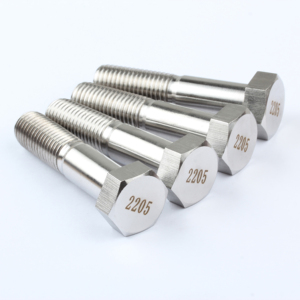
Featuring a PREN value exceeding 42. Excellent resistance to chloride pitting, crevice corrosion, and stress corrosion cracking (SCC) for marine scrubbers, offshore oil rigs, and desalination evaporators.
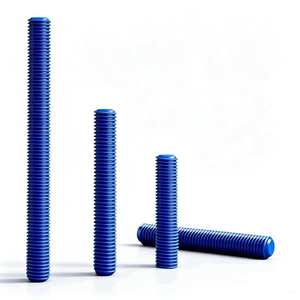
Designed specifically for offshore splash zones and acidic soil environments. Achieves over 3,000 hours of neutral salt spray testing (ASTM B117) with uniform low torque coefficients for accurate preload tension.
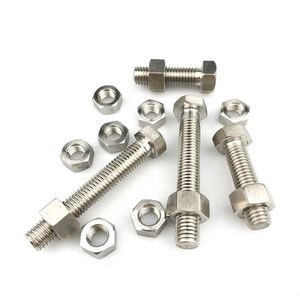
Class 12.9 high-strength superalloy fully threaded studs. Resists thermal embrittlement up to 700°C and wet chlorine attack. Fully documented with EN 10204 3.1 & NACE MR0175 sour service compliance.
Continuous thread studs are structurally engineered without an unthreaded shank, eliminating cross-sectional stress concentrations and distributing clamping tension evenly across the full engagement length. This geometry makes them mandatory for high-pressure ASME B16.5, B16.47 piping flanges and API 6A pressure-retaining manifolds.
| Material Classification | Common Standard Grades | Tensile Strength (MPa) | Yield Strength (MPa) | Service Temp Range | Primary Industrial Use-Cases |
|---|---|---|---|---|---|
| Alloy Carbon Steel | ASTM A193 B7 / A320 L7 | 860 – 1000 | 720 min | -46°C to 425°C | Standard refinery piping, boiler drums, pressure vessels |
| Austenitic Stainless | AISI 304 (A2-70) / 316 (A4-80) | 700 – 800 | 450 – 600 | -196°C to 550°C | Cryogenic storage, chemical processing plants, marine hardware |
| Duplex / Super Duplex | 2205 (UNS S32205) / 2507 (S32750) | 750 – 1000 | 550 – 750 | -50°C to 300°C | Desalination facilities, seawater scrubbers, subsea manifolds |
| Nickel Superalloys | Inconel 718 (N07718) / Hastelloy C276 | 1100 – 1400 | 850 – 1150 | -250°C to 700°C | Gas turbine casing, sour gas (H2S), nuclear reactor vessels |
| High-Tech Polymer | PEEK Polyether Ether Ketone | 90 – 110 | 80 – 100 | Up to 260°C | Semiconductor wafer handling, MRI shielding, aerospace cleanrooms |
*All raw materials undergo Optical Emission Spectrometry (OES) chemical validation, automated eddy-current defect checks, and Charpy V-notch impact validation down to cryogenic thresholds prior to precision roll-threading.
Strategic analysis for EPC procurement heads, technical buyers, and structural project managers navigating dynamic supply chains.
Industrial demand is rapidly transitioning beyond standard carbon steels toward Duplex 2205, 2507, and Inconel 718. As energy operators venture into ultra-deepwater drilling and high-temperature geothermal wells, our factories provide roll-threaded superalloy continuous rods designed to mitigate stress-corrosion cracking (SCC) and embrittlement.
Traditional hot-dip galvanizing is increasingly being replaced by multi-tier fluoropolymer systems, including base-layer zinc-nickel electroplating combined with heat-cured thermosetting PTFE (Polytetrafluoroethylene). This hybrid architecture achieves uniform friction control during hydraulic bolt tensioning and withstands 3,000+ hours in salt spray testing.
European and American regulatory bodies are standardizing on full raw-material traceability. Our facility provides certified digital dossiers accompanying each batch, containing EN 10204 3.1 Inspection Certificates, 3.2 Third-Party Witnessed Reports (DNV, Lloyd’s, SGS, TÜV), melt source details, and ultrasonic non-destructive testing (NDT) records.
Precision-rolled threads are superior to traditional CNC single-point turned threads for critical heavy-duty bolted assemblies. The following engineering comparison illustrates why certified EPC projects require cold-rolled studs:
Metal fibers are displaced rather than severed, resulting in unbroken grain flow along the thread crests and roots. This cold-work hardening increases root hardness, yields a burnished Ra 0.4 μm root finish, and improves cyclic fatigue life by up to 35% under pulsing pipeline pressures.
Machining shears across the material's longitudinal grain boundaries, introducing micro-notches and micro-voids at thread roots. These microscopic irregularities act as stress concentration points under high mechanical preloads, elevating susceptibility to hydrogen-induced stress cracking.
Our integrated manufacturing facilities deliver full end-to-end quality control from certified bar stock to final coated and threaded fasteners.
Our facilities operate under strict ISO 9001:2015 quality management procedures and hold TÜV Rheinland certifications for Pressure Equipment Directive (PED 2014/68/EU), qualifying our bolts for major European power, nuclear, and chemical installations.
Fasteners destined for upstream oil and sour natural gas extraction undergo controlled vacuum heat treatment to maintain surface and core hardness below 22 HRC, preventing sulfide stress cracking (SSC) in accordance with NACE MR0175 / ISO 15156 standards.
Equipped with modern two-die and three-die hydraulic thread-rolling machines capable of processing high-tensile bar diameters from M6 through M100 (1/4" to 4" UNC/UNF/8UN) with standard continuous stock lengths up to 6 meters.
Direct technical guidance on material selection, surface coatings, testing standards, and logistics for industrial stud bolt sourcing.
Connect with our technical engineering sales desk for mill test certificates, custom roll-threaded drawings, and volume pricing. We respond to industrial RFQs within 24 hours.
Get a Quote