
Engineered to international specifications including ASME B18.31.2, DIN 938, DIN 939, DIN 835, and customer-specific engineering prints.
A comprehensive examination of shear-plane mechanics, engagement ratios, fatigue performance, and corrosion mitigation in mission-critical OEM assemblies.
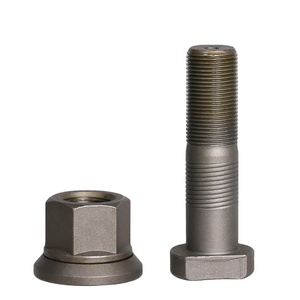
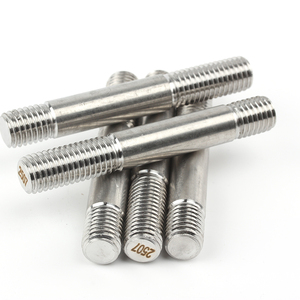
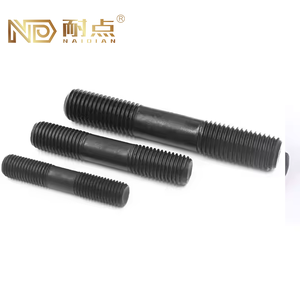
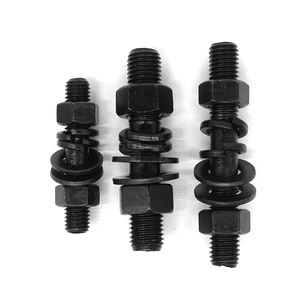
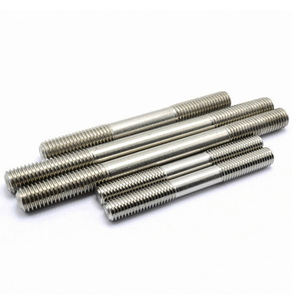
In high-pressure piping manifolds, deep-sea subsea wellheads, and heavy reciprocating engine blocks, double-ended studs deliver substantial mechanical superiority over conventional headed hex bolts. Unlike a standard bolt which transmits rotational torsion directly through the entire shaft during torquing, a double-ended stud isolates tightening stresses exclusively to the nut engagement region. This structural mechanics distinction eliminates concurrent torsional shear and pure axial tensile loading, directly preventing premature yield failure and ensuring precise joint preloads.
Tap ends adhere to distinct thread interference fits (such as ASME Class 5 interference or DIN 938/939 metal-to-metal contact standards) to permanently anchor into cast blocks, while the opposite end utilizes Class 2A/6g tolerances for repeatable friction-controlled nut torqueing.
TorqBolt utilizes precision cold-die thread rolling rather than single-point cutting. This work-hardens thread roots, maintains continuous grain boundary lines without micro-notches, and boosts cyclic fatigue resistance by up to 35% in high-vibration power systems.
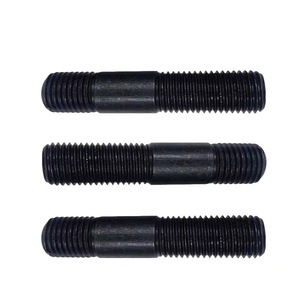
By engineering reduced or full-body shanks between threaded sectors, thermal elasticity is enhanced. Reduced shank studs provide uniform strain distribution along the unthreaded body, absorbing shock energy during sudden cyclic pressure surges without plastic deformation.
Selecting the optimal alloy requires balancing yield strength, localized pitting resistance (PREN), and temperature-induced stress relaxation. Below is our benchmark reference guide for critical OEM applications:
| Material Designation | UNS / Standard | Yield Strength (Min, MPa) | Tensile Strength (MPa) | Operating Temp Range | PREN Rating | Typical Critical Application |
|---|---|---|---|---|---|---|
| Super Duplex 2507 | UNS S32750 / EN 1.4410 | 550 | 750 – 1000 | -50°C to 250°C | ≥ 42 | Subsea manifolds, desalination, high-chloride piping |
| Alloy Steel ASTM A193 B7 | AISI 4140 Quenched & Temp. | 725 | 860 (Min) | -30°C to 450°C | N/A | High-pressure valves, ASME B16.5 flange connections |
| Stainless 316 / B8M Cl. 2 | UNS S31600 (Strain Hardened) | 655 | 760 – 950 | -196°C to 400°C | 23 – 25 | Chemical processing plants, marine engine exhaust |
| Inconel 718 | UNS N07718 / NACE MR0175 | 1,034 | 1,240 – 1,450 | -250°C to 650°C | ≥ 50 | Aerospace propulsion, HPHT sour gas downhole valves |
| Carbon Steel 10.9 / 12.9 | ISO 898-1 Standard | 900 / 1,080 | 1,000 / 1,220 | -40°C to 300°C | N/A | Automotive powertrain, heavy industrial gearboxes |
| Titanium Grade 5 | Ti-6Al-4V / UNS R56400 | 828 | 895 – 1,000 | -250°C to 400°C | Immune (Amb.) | Motorsport racing chassis, naval sonar housings |
A vertically integrated production infrastructure headquartered in Mumbai with state-of-the-art forging and precision CNC centers in Rajkot, Gujarat.
We combine heavy hot forging for large-diameter exotic studs (up to M120 / 4-1/2") with precision CNC turning centers for intricate tap tolerances. This dual approach ensures cost competitiveness regardless of production batch scale.
Our quality system is certified under the European Pressure Equipment Directive (PED). TorqBolt products satisfy catastrophic risk parameters, permitting immediate deployment across pressure vessels, autoclaves, and nuclear infrastructure.
Every single double-ended stud is hard-stamped with melt heat codes and grade identifiers. Comprehensive chemical, Charpy V-notch impact, tensile, and micrographic test documentation accompanies every delivery consignment.
For aggressive H2S sour gas environments, our heat treatments ensure core hardness levels remain strictly below HRC 22 or 35 (grade dependent), shielding the assembly from catastrophic Sulfide Stress Cracking (SSC).
Anticipating supply-chain realignment, environmental standards, and advanced metallurgical coatings across the 2025–2030 horizon.
Global environmental mandates (REACH / RoHS) are driving procurement teams away from Cadmium electroplating. The future standard is multi-layer ceramic-fluoropolymer PTFE systems and zinc-nickel flakes that achieve over 3,000 hours of ASTM B117 salt spray exposure without hydrogen embrittlement risks.
Procurement teams increasingly mandate digital QR or RFID asset tracking etched directly on the stud shank. This unlocks cloud-stored mill certificates, ultrasonic test results, and dimensional inspection scans in seconds during site installation audits.
Modern supply chains avoid fragmented tier-2 vendors. Buyers are moving toward consolidated master distributors who deliver mixed shipments of high-volume ASTM A193 B7 alongside low-volume exotic titanium and super duplex studs on unified lead times.
Clear, technical insights to help procurement specialists, piping engineers, and quality assurance inspectors make informed decisions.
Direct communication with our technical metallurgical engineers in Mumbai and Rajkot. Get drawing reviews, material selections, and formal pricing within 24 hours.