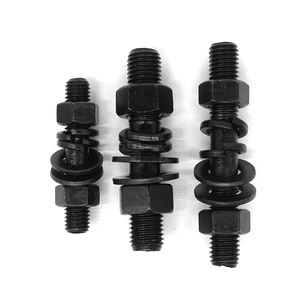
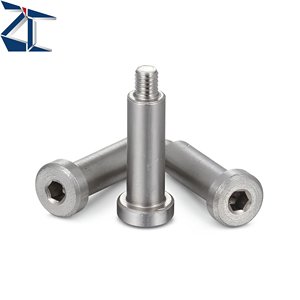
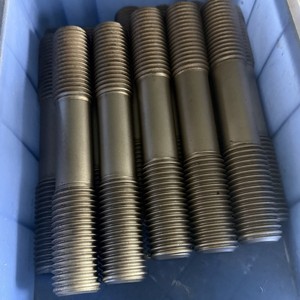
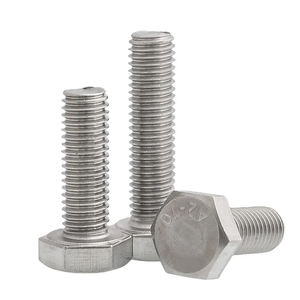
Our precision manufacturing lines process hot-forged superalloys, non-ferrous titanium, and high-tensile stainless steels adhering directly to DIN, ISO, ASTM, and client-specific OEM blueprints.
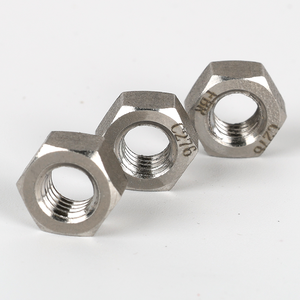
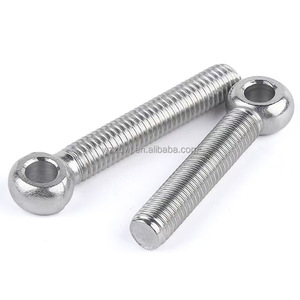
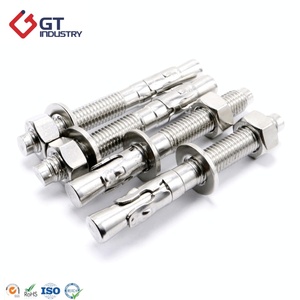
Selecting mechanical fasteners for aerospace airframes, avionics bays, and gas turbine propulsion requires balancing density, tensile-shear performance, thermal creep stability, and galvanic compatibility.
Combustion zones and afterburners operate well beyond the annealing points of conventional alloys. Fasteners must withstand continuous cyclic heat without catastrophic thermal creep or stress-relaxation.
Primary structures demand fasteners with high strength-to-weight ratios, tight fatigue shear cycles, and galvanic neutrality when interfaced with Carbon Fiber Reinforced Polymers (CFRP).
Liquid hydrogen (LH2) and liquid oxygen (LOX) rocket staging involve cryogenic embrittlement hazards, requiring ductile face-centered cubic lattice structures.
| Alloy Grade | UNS / Standard | Tensile Strength (MPa) | Thermal Ceiling | Primary Aerospace Subsystem | Anti-Galling / Surface Finish |
|---|---|---|---|---|---|
| Inconel 718 | UNS N07718 / AMS 5663 | 1,240 – 1,400 | 650°C (1,200°F) | Jet Engine Rotor Flanges & Turbines | Silver Plated / MoS2 |
| Titanium Gr. 5 | UNS R56400 / AMS 4928 | 895 – 1,000 | 400°C (752°F) | CFRP Airframe Wing Spars & Skin Fasteners | Anodized Type II |
| Hastelloy C276 | UNS N10276 / ASTM B574 | 690 – 780 | 1,000°C (Oxidation) | Exhaust Nacelles & Fuel Vent Scrubbers | Passivated / Plain |
| 17-4 PH (H900) | UNS S17400 / AMS 5643 | 1,310 – 1,450 | 315°C (600°F) | Landing Gear Struts & Hydraulic Valves | Cadmium-Free Zn-Ni |
| AISI 316L | UNS S31603 / ISO 3506-1 | 700 – 800 (Cold Worked) | 450°C / Down to -196°C | Cryogenic Manifolds & Ground Radomes | Electropolished |
Global tier-1 airframe integrators and defense contractors are transforming their supply chains from legacy transactional buys to strategic, vertically integrated OEM/ODM frameworks.
Procurement protocols under AS6174 and DFARS 252.225-7014 mandate granular, tamper-proof traceability. Procurement officers no longer accept isolated mill certs; every batch must provide a digital audit trail mapping virgin melt furnace heats, hot-heading thermals, and dimensional calibration records.
Recent supply shocks have accelerated dual-sourcing architectures. Defense and commercial aerospace procurement officers prioritize manufacturers with self-contained forging, heat treatment, threading, and inspection facilities to mitigate trade volatility and tariff exposure.
The phasing out of hexavalent chromium and cadmium platings has triggered a procurement push toward Zinc-Nickel (Zn-Ni) electroplating, advanced PTFE fluoropolymers, and aluminum ceramic slurry coatings that deliver 1,000+ hour salt-spray endurance without hydrogen embrittlement.
From grain-flow preservation in thread rolling to hybrid additive manufacturing, fastener fabrication continues to advance to meet strict aerospace fatigue requirements.
Unlike commercial fasteners where threads are machined or rolled before thermal processing, aerospace bolting specifies thread rolling after final solution annealing and age-hardening. This mechanical work induction creates residual compressive stresses at thread roots, extending fatigue lifespan by up to 400% under cyclical flight loads.
Ultrasonic piezoelectric transducer thin films and integrated RFID sensor caps are transitioning from test cells to series airframes. These sensors allow aircraft line-maintenance technicians to measure true axial clamping force and preload retention instantly without breaking joint seals.
Nickel-base superalloys work-harden almost instantaneously under cold strain. High-frequency digital induction heading maintains workpiece blanks within narrow forging windows (±15°C), preventing micro-cracking and achieving unbroken grain boundary orientation from shank through head fillets.
Operating from primary production hubs with integrated forging and high-precision CNC machining plants, we engineer specialty fasteners for severe operating environments worldwide.
Our manufacturing centers operate under certified ISO 9001:2015 quality frameworks and Pressure Equipment Directive (PED 2014/68/EU) certification audited by TÜV Rheinland. We supply full EN 10204 3.1 inspection documentation with every heat lot, with EN 10204 3.2 third-party inspection (Lloyd's, DNV, Bureau Veritas) available on demand.
We operate high-speed cold headers for micro avionics fasteners and hydraulic hot-forging presses for large-diameter flange bolting up to M100 (4 inches). For non-standard profiles, complex shoulders, and low-run aerospace prototypes, multi-axis Swiss CNC turning centers deliver micro-inch precision.
Every manufacturing run undergoes rigorous in-house metallurgical and non-destructive examination (NDE). Our lab is equipped for Positive Material Identification (XRF & OES spectrometry), Charpy V-notch impact testing down to cryogenic temperatures (-196°C), tensile/yield stress analysis, Vickers/Rockwell micro-hardness mapping, and optical micro-structure evaluation.
Detailed answers to technical, commercial, and metallurgical questions commonly raised by aerospace procurement directors and quality assurance engineers.
Accelerate your engineering review by providing key project parameters: Material UNS Grade, Dimensional Standard or 2D Blueprint, Thread Pitch Class (UNJ/Metric), Hardness Limits, Coating Requirements, and Target Delivery Timelines.