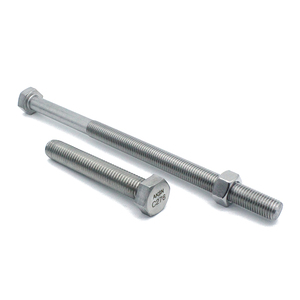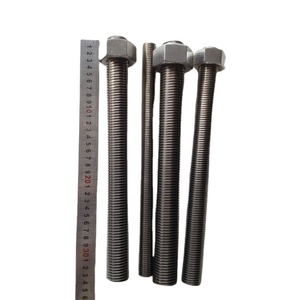
Manufactured under strict ISO 9001:2015 and PED 2014/68/EU protocols. Full EN 10204 3.1 & 3.2 heat traceability for sour service downhole and chemical applications.
A comprehensive engineering breakdown of precipitation-hardened Incoloy 925 bolting performance in sour, acidic, and ultra-high-pressure oilfield manifolds.
Incoloy 925 (UNS N09925) is a precipitation-hardenable, nickel-iron-chromium-molybdenum-copper alloy designed specifically to bridge the mechanical gap between work-hardened austenitic alloys and expensive nickel superalloys. By augmenting the core corrosion resistance of Incoloy 825 with controlled additions of titanium (1.9–2.4%) and aluminum (0.1–0.5%), Incoloy 925 achieves significant precipitation strengthening during age hardening (forming gamma prime γ' phase Ni₃(Al, Ti) precipitates). For high-pressure, high-temperature (HPHT) sour well completions, downhole equipment, and marine subsea tree installations, Incoloy 925 fasteners provide outstanding tensile capabilities paired with extraordinary immunity to sulfide stress cracking (SSC) and stress-corrosion cracking (SCC).
In accordance with NACE MR0175 / ISO 15156-3, bolting materials utilized in sour environments must undergo precision thermal cycles to prevent brittle fracture paths along grain boundaries. Our manufacturing route enforces solution annealing at 980°C to 1040°C followed by controlled precipitation age-hardening (typically at 720°C–760°C for 6 to 9 hours, followed by furnace cooling to 620°C for an additional 8 hours). This ensures an optimal microstructural balance: securing a minimum yield strength of 655 MPa (95 ksi) and tensile strength exceeding 965 MPa (140 ksi), while maintaining bulk hardness strictly within the 38 to 40 HRC upper envelope mandated by downhole oilfield operators.
| Material Grade | UNS / DIN | Yield Strength (0.2% Offset, MPa) | Tensile Strength (MPa) | Pitting Resistance (PREN) | Primary Sour Service Advantage |
|---|---|---|---|---|---|
| Incoloy 925 | UNS N09925 / 1.4529 Mod | ≥ 655 - 750 | ≥ 965 - 1100 | ≥ 38 - 42 | High strength + NACE MR0175 compliance without work hardening |
| Incoloy 825 | UNS N08825 / 2.4858 | ≥ 240 - 310 | ≥ 585 - 650 | ≥ 31 - 34 | Excellent acid resistance, lower mechanical load limits |
| Inconel 718 | UNS N07718 / 2.4668 | ≥ 1030 | ≥ 1240 | ≥ 48 - 52 | Maximum yield strength, higher material & machining cost |
| Super Duplex 2507 | UNS S32750 / 1.4410 | ≥ 550 | ≥ 750 - 800 | ≥ 42 - 44 | High pitting resistance; limited to operating temps ≤ 250°C |
Controlled aging precipitates gamma-prime phase Ni₃(Ti,Al), achieving bolt yield capacities above 100 ksi without inducing directional cold-work micro-cracks.
CNC threads rolled after solution heat-treatment eliminate microscopic shear tearing, drastically elevating cyclic fatigue resistance in pulsing pressure headers.
Molybdenum (2.5–3.5%) and copper (1.5–3.0%) matrix stabilization eliminates pitting initiation in wet crude containing dissolved chlorides, CO₂, and H₂S.
Market insights and strategic shifts driving global engineering procurement organizations toward Incoloy 925 over traditional nickel and duplex alloys.
Over the next decade, energy extraction and offshore refining will encounter deeper, hotter, and increasingly sour reservoirs. Traditional duplex and standard super duplex stainless steels encounter brittle phase transitions (sigma phase precipitation) at temperatures approaching 280°C, rendering them unsuitable for deep HPHT reservoirs. Meanwhile, ultra-high-grade alloys such as Inconel 718 impose budget constraints on multi-kilometer pipeline connectors and massive offshore skids. As a consequence, procurement trends demonstrate an accelerated transition toward Incoloy 925 due to its distinct metallurgical cost-to-performance ratio.
With subsea injection wells encountering elevated geothermal gradients and higher partial pressures of H₂S, engineering specifications are migrating from UNS S32750 to UNS N09925 to sidestep embrittlement risks while retaining high preload retention.
Major EPC contracts increasingly require third-party witnessed inspection certificates (EN 10204 3.2 by DNV, Lloyd's, or TÜV) for every individual heat lot, covering Charpy V-Notch impacts at -46°C, positive material identification (PMI), and macro-etching.
Pure mechanical torquing on nickel-base fasteners often causes severe thread galling. Forward-looking procurement teams demand factory-applied ceramic-PTFE or Xylan fluoropolymer coatings with documented torque tension coefficients (K-factor 0.12–0.14).
To qualify for deep downhole completions, purchasers specify stricter hardness limits than legacy standards—often limiting peak readings to 38 HRC to prevent micro-fissuring under elevated cathodic protection potential.
Exotic alloy fasteners reduce catastrophic downtime risk in offshore processing. Plant operators factor in life-cycle integrity assessments, where Incoloy 925 demonstrates a 300% operational lifespan extension compared to standard 316L/B8M systems.
Paper mill test reports are transitioning to cryptographic digital QR tracking stamped directly on bolt shanks, linking field engineers directly to melt chemistry, heat-treatment logs, and ultrasonic test signatures.
Combining hot forging, precision cold heading, CNC bar-turning, and proprietary heat-treating furnaces under a certified ISO 9001:2015 and PED 2014/68/EU quality regime.
Continuous uninterrupted grain-flow heading from M6 to M100 (1/4" to 4" diameter). Eliminates longitudinal cracking under severe dynamic stress.
Multi-zone electric heat-treating systems with calibrated thermocouples ensuring +/- 5°C uniformity across multi-stage solution annealing and aging sequences.
Complete mechanical and metallurgical verification: computerized tensile tests, Charpy impact down to -196°C, Vickers/Rockwell hardness, and optical emission spectrometry.
Turnkey finishing including PTFE fluorocarbon coating, Xylan 1070/1424, electro-zinc, hot-dip galvanizing, and chemical passivation for extreme marine environments.
Direct technical answers addressing critical sourcing, testing, compliance, and installation questions for project managers and QA/QC inspectors.