Explore high-integrity fastening solutions manufactured under rigid metallurgical control. From lightened Titanium Gr5 configurations to critical nickel, super duplex, and structural bolting systems.
Titanium Grade 5 (UNS R56400 / Werkstoff 3.7165) represents the alpha-beta benchmark in critical mechanical engineering. Understanding its metallurgy is essential for reliable procurement and deployment.
| Property / Characteristic | Titanium Gr5 (Ti-6Al-4V) | Duplex 2507 (UNS S32750) | Inconel 718 (UNS N07718) | Structural Steel (Gr 12.9) |
|---|---|---|---|---|
| Density (g/cm³) | 4.43 (Super-Lightweight) | 7.80 | 8.19 | 7.85 |
| Tensile Strength (Yield) | 895 - 1000 MPa (828 MPa) | 750 - 1000 MPa (550 MPa) | 1240 - 1400 MPa (1030 MPa) | 1220 MPa (1100 MPa) |
| Specific Strength Ratio | 215 kN·m/kg (Industry Benchmark) | 115 kN·m/kg | 160 kN·m/kg | 155 kN·m/kg |
| Corrosion Resistance Profile | Immune to ambient Seawater, Chlorides, Wet Chlorine | PREN > 42, Resistant to Pitting | High Temp Oxidation & Pitting Resistance | Requires Plating / Passivation |
| Manufacturing Protocol | Hot Heading & CNC Thread Rolling in Argon | Cold / Hot Forging + Solution Anneal | Hot Forging + Age Hardening | Cold Heading & Quench/Temper |
Operating dedicated production pipelines, our facilities combine hot forging, precision cold heading, and multi-axis CNC machining under stringent ISO 9001:2015 and PED 2014/68/EU frameworks.
Unlike commercial commodity distributors, our production specializes in titanium alloys, nickel superalloys (Inconel 625, 718, Hastelloy C-276), and Super Duplex 2507, maintaining rigid heat chemistry controls.
Full compliance with international standards for pressure vessel components, subsea infrastructure, and safety-critical assemblies, backed by witnessed test protocols and qualified quality engineers.
Total metallurgical pedigree from certified ingot to rolled threads. Each production lot is dispatched with authentic chemical, mechanical, and PMI analysis certificates cross-referenced by melt heat numbers.
Preserving uninterrupted grain flow lines across bolt heads and transitions. This technique eliminates brittle micro-fissuring and significantly amplifies fatigue lifecycle in cyclic load environments.
Threads are cold or warm rolled after precision centerless grinding, hardening root radii and leaving compressive residual stress that mitigates stress corrosion cracking (SCC) under tension.
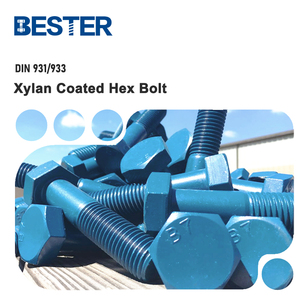
Proprietary Xylan, PTFE, MoS2, and anodizing treatments specifically formulated to prevent micro-welding and thread galling between titanium mating surfaces under severe preload torques.
Market requirements for titanium and high-performance fasteners are shifting rapidly due to clean energy transitions, deep-water extraction, and weight-critical structural design.
As green hydrogen electrolyzers and transport pipelines expand, titanium and specialized superalloys are replacing classic high-tensile steels to prevent fatal atomic hydrogen embrittlement at elevated pressure ratings.
Global EPC contractors require instant digital cross-referencing between physical fastener markings and EN 10204 3.1 documentation, leading to laser 2D matrix micro-engraving on structural bolt heads.
Advanced hot-heading in protective argon/vacuum atmospheres eliminates the alpha-case oxygen-enriched brittle crust on titanium fasteners, reducing post-machining chemical milling costs by up to 25%.
Direct technical answers to common queries submitted by mechanical engineers, purchasing managers, and quality control inspectors.
While Grade 2 Titanium offers outstanding general corrosion resistance, its tensile yield is limited (approx. 275-350 MPa). Titanium Gr5 (Ti-6Al-4V) is heat-treatable and reaches minimum tensile strengths exceeding 895-1000 MPa, providing structural load capacities comparable to 10.9-grade alloy steel at half the physical mass.
Titanium naturally forms an adhesive oxide film that can cause severe micro-welding (galling) when tightened dry. We prevent this by providing micro-tolerance rolled threads combined with molybdenum disulfide (MoS2) dry-film coatings, PTFE fluoropolymer layers, or controlled micro-arc oxidation treatments.
We manufacture to DIN 931, DIN 933, DIN 912, ISO 4014, and ISO 4017, as well as aerospace-grade AMS 4928/AMS 4967 and industrial ASTM B348 / ASTM F468 specifications, including full UNC, UNF, and metric thread pitch compliance.
Shipments include EN 10204 3.1 inspection certification confirming spectroscopic melt analysis, tensile yield, elongation, reduction of area, Charpy impact test data (where required), ultrasonic/eddy-current testing, and dimensional compliance reports.